



High quality sinking fish feed plays an important role in modern aquaculture. Many fish species feed below the water surface, making sinking pellets an effective feeding option for specific farming systems. However, producing high quality sinking fish feed is not simply a matter of pressing ingredients into pellets. The nutritional formula, raw material quality, particle size, mixing uniformity, moisture, pellet density, drying, cooling, screening, and packaging all influence the final product.
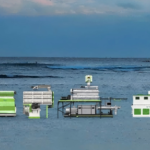
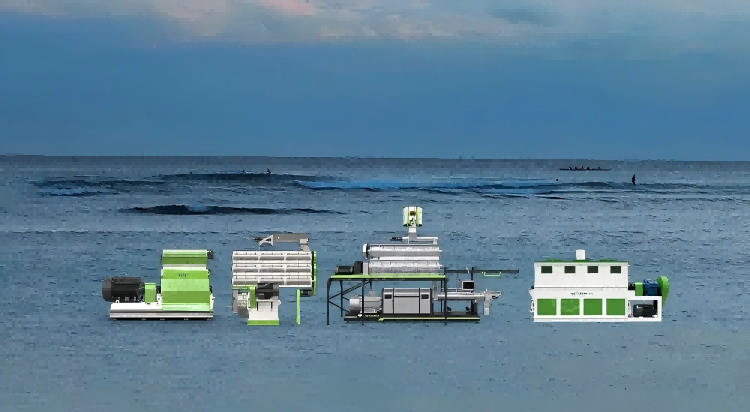
For commercial fish feed manufacturers, a complete processing system is needed to consistently produce stable and uniform sinking feed. A sinking fish feed production machine should therefore be understood as a complete set of fish feed processing equipment rather than a single pellet mill. Depending on the production requirements, it may include raw material cleaning equipment, hammer mills, superfine grinders, batching systems, mixers, conditioners, pelletizing equipment, dryers, coolers, screening machines, coating systems, packing machines, conveyors, and control systems.
The goal of a well-designed production line is to transform selected raw materials into nutritionally balanced, mechanically strong, appropriately dense, and storage-stable sinking fish feed.
This article explains how to produce high quality sinking fish feed and how the complete production process and equipment work together to achieve consistent results.
What Makes High Quality Sinking Fish Feed?
Before discussing the production process, it is important to understand what defines high quality sinking fish feed.
A good sinking pellet should have several important characteristics.
Appropriate Sinking Speed
The feed should sink at a speed suitable for the target fish species and feeding behavior.
The objective is not necessarily to make the pellet sink as quickly as possible. Different fish have different feeding habits, so the required sinking characteristics can vary.
Uniform Pellet Size
Pellets should have consistent diameters and shapes.
Uniformity helps fish consume feed more efficiently and reduces the amount of uneaten feed.
Good Mechanical Durability
The pellets should be strong enough to withstand conveying, packaging, transportation, and feeding without excessive breakage.
Good Water Stability
Sinking pellets should maintain their structure for an appropriate period after entering water.
If pellets disintegrate too quickly, nutrients can be lost before the fish consume them.
Consistent Nutritional Distribution
Each pellet should contain a reasonably uniform distribution of the ingredients included in the formula.
This requires accurate batching and effective mixing.
Suitable Moisture Content
Finished feed should contain an appropriate amount of moisture for storage and transportation.
Excessive moisture can reduce storage stability, while excessive drying can waste energy and potentially affect product quality.
1. Start with a Suitable Feed Formula
High quality feed begins with a well-designed formula.
The exact formula depends on the fish species, growth stage, feeding behavior, farming environment, and nutritional requirements.
A typical sinking fish feed formula may contain several categories of ingredients.
Protein Sources
Protein is essential for fish growth and tissue development.
Common protein sources include:
- Fish meal
- Soybean meal
- Corn gluten meal
- Rapeseed meal
- Peanut meal
- Poultry by-products
- Other suitable animal and plant protein sources
The selection and ratio of these ingredients depend on the target feed formula.
Energy Sources
Cereal ingredients such as corn, wheat, rice bran, and wheat bran can contribute energy and influence pellet structure.
Their processing characteristics should also be considered when designing the production process.
Oils and Fats
Fish oil and vegetable oils can provide concentrated energy and improve the nutritional characteristics of the feed.
However, excessive oil added before pelletizing may interfere with pellet formation. Some oil can therefore be applied after pelletizing through a coating system.
Vitamins and Minerals
Vitamin and mineral premixes help provide essential micronutrients.
Because they are usually included at relatively low levels, accurate batching and thorough mixing are particularly important.
Functional Additives
Depending on the feed formula, manufacturers may also use amino acids, attractants, enzymes, probiotics, binders, antioxidants, and other functional ingredients.
Some additives are sensitive to heat, so the point at which they enter the production process should be carefully considered.
2. Use High Quality Raw Materials
Even the most advanced equipment cannot compensate for poor-quality raw materials.
Before production, raw materials should be checked for moisture, contamination, freshness, and physical condition.
Materials should be stored under appropriate conditions to prevent:
- Moisture absorption
- Mold growth
- Pest contamination
- Cross-contamination
- Nutrient degradation
Bulk ingredients can be stored in silos or storage bins, while smaller ingredients and premixes can be stored in bags or dedicated bins.
Good storage management provides a stable starting point for the entire production process.
3. Clean the Raw Materials
The next step is raw material cleaning.
Agricultural and feed ingredients may contain stones, metal fragments, dust, fibers, and other foreign materials.
A cleaning section removes these impurities before the ingredients enter the main processing equipment.
Typical equipment includes cleaning screens, magnetic separators, destoners, and dust collection systems.
A magnetic separator is particularly important for removing ferrous metal particles.
Effective cleaning provides two major benefits.
First, it protects downstream machines from damage.
Second, it improves the cleanliness and safety of the finished feed.
4. Achieve the Right Particle Size
Particle size has a major influence on sinking fish feed quality.
Large particles can make mixing more difficult and may produce rough or weak pellets.
Fine and relatively uniform particles can help create a more compact pellet structure.
A hammer mill is commonly used for reducing the particle size of cereal grains and other ingredients.
For some aquatic feed formulas, especially those requiring very small pellet sizes, a superfine grinding machine can be added.
The ideal particle size depends on the formula and target pellet size.
Grinding too coarsely can reduce pellet quality, while unnecessarily fine grinding can increase energy consumption and processing costs.
Therefore, grinding should be optimized rather than simply maximized.
5. Use Accurate Batching
After grinding, the ingredients need to be weighed according to the feed formula.
Accurate batching is essential because fish feed formulas often contain both major ingredients and very small quantities of additives.
An automatic batching system can improve the accuracy and consistency of the production process.
It can also reduce manual weighing errors and improve production efficiency.
A well-designed batching system should be capable of handling different ingredient quantities according to the production formula.
6. Mix the Ingredients Thoroughly
After batching, the ingredients are transferred to a feed mixer.
The purpose of mixing is to distribute all ingredients evenly throughout the feed mixture.
Uniform mixing is especially important for fish feed because vitamins, minerals, amino acids, and other additives may be used at relatively low inclusion rates.
If mixing is insufficient, nutrient distribution can become inconsistent.
A good mixer should achieve uniformity without excessive mixing time or material segregation.
Liquid ingredients can also be added when required.
7. Control Moisture and Conditioning
Before pelletizing, the feed mixture may need to be conditioned.
Conditioning adjusts moisture and temperature and can improve the physical properties of the feed material.
Steam conditioning is commonly used in commercial feed production.
The heat and moisture can soften the material and improve binding.
For sinking fish feed, conditioning should be controlled according to the desired pellet density and structure.
Excessive expansion is generally undesirable when the objective is to produce dense sinking pellets.
The appropriate conditioning conditions depend on the formula, raw materials, moisture, pellet diameter, and pelletizing technology.
8. Optimize the Pelletizing Process
Pelletizing converts the prepared feed mixture into pellets.
The material is compressed through die holes to form pellets with a specific diameter.
Important factors include:
- Die hole diameter
- Die compression ratio
- Roller adjustment
- Feed rate
- Moisture
- Conditioning
- Raw material properties
These factors influence pellet density, durability, shape, and production capacity.
For sinking feed, the pelletizing process should create a sufficiently dense structure without causing unnecessary damage to the nutritional components.
It is important to remember that pelletizing is only one stage of the production process.
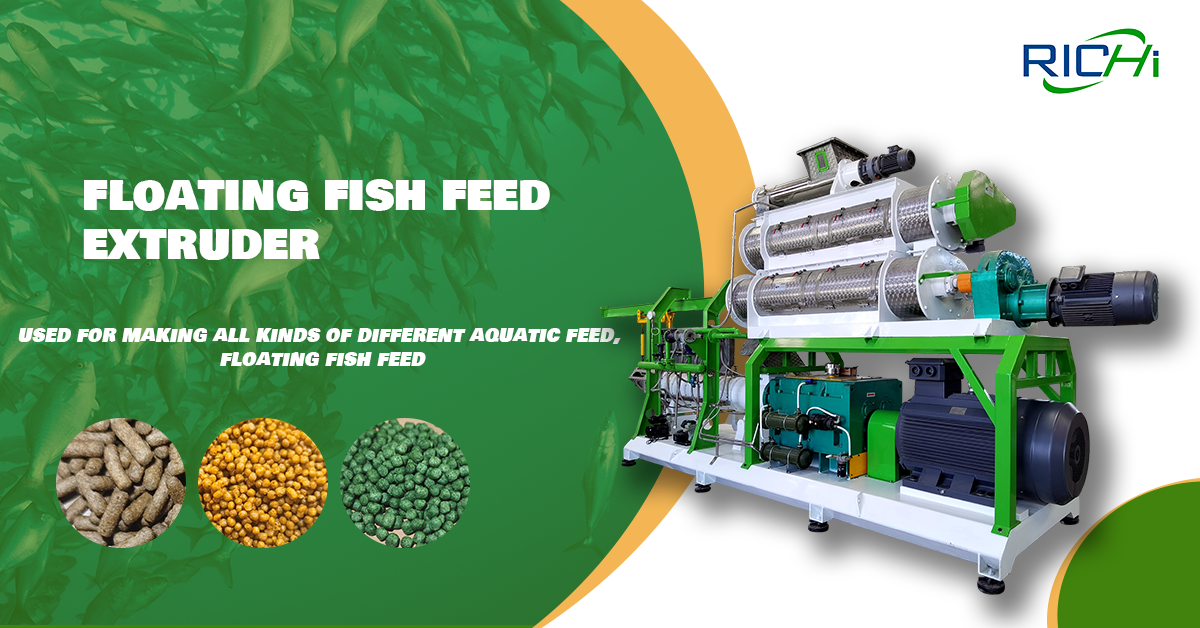
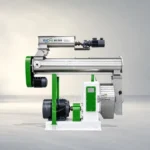
A commercial sinking fish feed production machine is not simply a pellet mill. In practical production, it refers to a complete set of equipment that handles the entire process from raw material preparation to final packaging.
9. Dry the Fresh Pellets Properly
After pelletizing, the fresh pellets generally contain more moisture than is suitable for long-term storage.
A dryer is therefore used to reduce moisture.
Drying should be controlled carefully.
Insufficient drying can leave excessive moisture in the product, reducing storage stability.
Excessive drying can increase energy consumption and may negatively affect product quality.
The drying process depends on:
- Initial moisture
- Pellet size
- Air temperature
- Airflow
- Residence time
- Production capacity
The dryer should have sufficient capacity to match the output of the pelletizing section.
10. Cool the Pellets
After drying, the pellets remain hot.
They need to be cooled before screening and packaging.
A pellet cooler reduces temperature and helps stabilize moisture distribution.
Cooling also reduces the risk of condensation inside the packaging.
For continuous commercial production, a counterflow cooler or another suitable industrial cooling system can be integrated into the line.
11. Screen the Finished Pellets
After cooling, the pellets pass through a screening machine.
The purpose of screening is to separate qualified pellets from fines and oversized particles.
Screening improves:
- Pellet uniformity
- Product appearance
- Feeding consistency
- Packaging quality
Fine powder can often be returned to the production process.
The screen specifications should be selected according to the required pellet diameter.
12. Apply Oil or Functional Additives When Necessary
Some high quality fish feed products require post-pellet coating.
A coating machine can apply oil, attractants, or other suitable liquid additives to the pellet surface.
This method can be useful when certain ingredients should not be exposed to the temperatures used during conditioning and pelletizing.
Post-coating also provides greater flexibility in controlling the energy density and palatability of the finished feed.
The coating system should distribute liquid ingredients evenly across the pellets.
13. Pack the Finished Feed Correctly
The final stage is packaging.
After screening and coating, the qualified pellets are transferred to a packing machine.
An automatic packing system can weigh, fill, and seal bags according to the required package size.
A complete packing system may include:
- Automatic weighing
- Bag filling
- Bag sealing
- Coding
- Conveying
- Palletizing
Good packaging protects the feed from moisture, contamination, and physical damage during transportation and storage.
How to Control the Sinking Characteristics
Producing high quality sinking fish feed requires control of pellet density and structure.
Several factors influence how pellets behave in water.
Formula Composition
Different raw materials have different densities and processing properties.
Protein meals, cereals, minerals, fibers, and other ingredients can all influence the density of the final pellet.
Therefore, sinking characteristics should be considered during formula development.
Grinding Fineness
Fine and uniform particles can contribute to a compact pellet structure.
However, the ideal grinding level depends on the target pellet size and formula.
Moisture
Moisture affects material behavior during pelletizing.
Stable moisture control helps maintain consistent pellet quality.
Compression
Pelletizing pressure influences pellet density and durability.
Appropriate compression helps create a strong and compact pellet.
Pellet Diameter
Pellet diameter affects feeding performance and water behavior.
The diameter should be selected according to the size and feeding ability of the target fish.
How to Improve Water Stability
Water stability is another important quality characteristic.
If sinking pellets break apart too quickly, nutrients may disperse into the water before the fish consume them.
Several factors influence water stability.
Particle Size
Uniform particle size can improve pellet structure.
Formula
The ingredients themselves affect binding and pellet durability.
Conditioning
Appropriate moisture and temperature can improve the physical properties of the feed.
Compression
Suitable pelletizing conditions help produce mechanically strong pellets.
Drying
Over-drying or uneven drying may negatively affect pellet quality.
Therefore, water stability should be considered as a result of the complete production process.
How to Select a Sinking Fish Feed Production Machine
When investing in a commercial feed production system, customers should evaluate the complete line rather than selecting one machine based only on its advertised capacity.
A suitable sinking fish feed production machine should be configured according to several key factors.
Production Capacity
The required capacity may range from a few hundred kilograms per hour to several tons per hour.
The capacities of the grinding, batching, mixing, pelletizing, drying, cooling, screening, and packing sections should be properly matched.
Raw Materials
The type and characteristics of raw materials determine the grinding and mixing requirements.
High-fiber ingredients may require different processing conditions from cereal-based formulas.
Pellet Size
The desired pellet diameter affects the die, screening system, and sometimes the grinding requirements.
If multiple pellet sizes are required, the line should be designed for convenient changeover.
Fish Species
Different fish species have different feeding habits and nutritional requirements.
The production line should therefore be designed around the actual products the manufacturer intends to produce.
Automation Level
A production line can be semi-automatic or highly automated.
Automatic batching, centralized control, automated conveying, process monitoring, and automatic packaging can reduce labor requirements and improve production consistency.
Factory Layout
The equipment arrangement should be designed around the available building space.
Material flow should be logical, with sufficient room for operation, maintenance, storage, and future expansion.
What Equipment Is Included in a Complete Sinking Fish Feed Production Machine?
The term sinking fish feed production machine can be misunderstood if it is treated as the name of a single piece of machinery.
For commercial applications, it is more appropriate to use the term to describe a complete set of fish feed processing equipment.
A complete line may include:
Raw Material Cleaning Equipment
Removes stones, metal particles, dust, and other impurities.
Hammer Mill or Superfine Grinder
Reduces raw materials to the required particle size.
Automatic Batching System
Accurately weighs ingredients according to the formula.
Feed Mixer
Produces a homogeneous mixture.
Conditioner
Adjusts temperature and moisture before pelletizing.
Pelletizing Equipment
Forms the feed mixture into pellets.
Fish Feed Dryer
Reduces moisture after pelletizing.
Pellet Cooler
Reduces pellet temperature and stabilizes the product.
Screening Machine
Separates qualified pellets from fines and oversized material.
Coating Machine
Applies oil and other suitable liquid additives.
Packing Machine
Weighs and packages the finished feed.
The system may also include storage bins, conveyors, bucket elevators, dust collection equipment, electrical control cabinets, and other auxiliary equipment.
Therefore, the production machine is essentially a complete processing system.
(Leanr more:https://pelletisingmachine.com/sinking-fish-feed-machine)
Common Quality Problems and Their Solutions
Excessive Fines
Too much powder can be caused by weak pellet structure, poor moisture control, unsuitable pelletizing parameters, or excessive mechanical impact.
The solution is to check the grinding, conditioning, pelletizing, cooling, and conveying processes together.
Poor Pellet Durability
Poor durability may be related to raw material characteristics, particle size, moisture, conditioning, or compression.
The entire process should be optimized rather than adjusting only the pellet mill.
Pellets Sink Too Fast
Excessive pellet density may cause the feed to sink faster than intended.
Formula composition and pelletizing conditions should be reviewed.
Pellets Do Not Sink Properly
If pellets remain near the surface, their density may be insufficient.
The formulation, expansion, moisture, and pelletizing conditions should be evaluated.
Uneven Pellet Size
Uneven pellet size can result from unstable feeding, inappropriate die specifications, worn components, or ineffective screening.
Regular maintenance and proper screening are important.
Poor Water Stability
Rapid breakdown in water can be related to formulation, particle size, conditioning, compression, or drying.
A complete process review is usually necessary.
Why a Complete Production System Is Important
High quality sinking fish feed is the result of coordinated processing.
Grinding affects mixing.
Batching affects formula accuracy.
Mixing affects nutrient distribution.
Conditioning affects pellet formation.
Pelletizing affects density and durability.
Drying affects moisture.
Cooling affects product stability.
Screening affects pellet uniformity.
Coating affects oil and additive distribution.
Packaging affects storage performance.
Because these processes are interconnected, a complete production system is usually more effective than selecting individual machines without considering the overall process.
The capacities of different machines should also be matched.
For example, if the pelletizing section can produce more feed than the dryer can process, the dryer becomes a bottleneck.
Similarly, an undersized mixer can limit the capacity of the entire line.
RICHI Complete Sinking Fish Feed Production Solutions
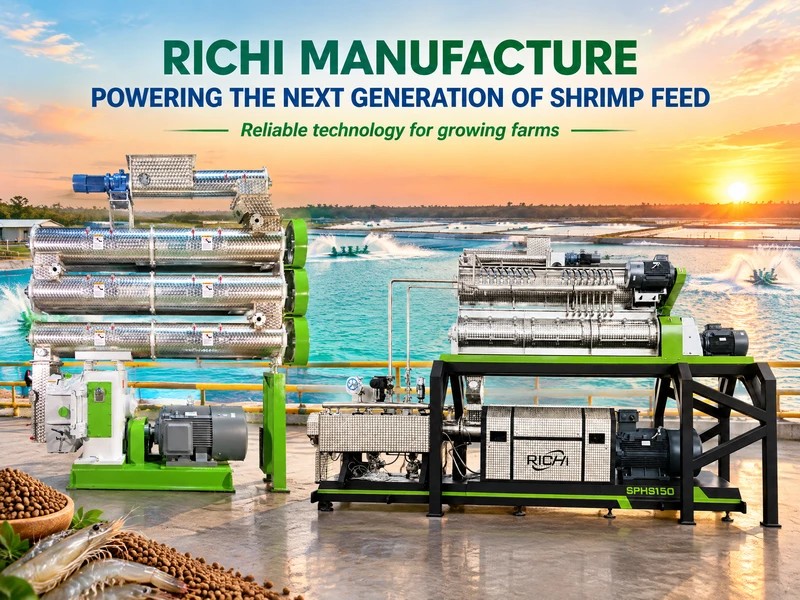
RICHI Manufacture provides complete fish feed production solutions for customers who need to manufacture sinking fish feed.
The production line can be customized according to the customer’s raw materials, formula, production capacity, pellet size, factory layout, and automation requirements.
A complete line can include:
Cleaning → Crushing → Batching → Mixing → Conditioning → Pelletizing → Drying → Cooling → Screening → Coating → Packing
For formulas requiring fine or superfine raw material particles, suitable grinding equipment can be included.
For products requiring additional oil or functional additives, a post-coating system can be integrated.
For large-scale commercial projects, automatic batching, centralized electrical control, automatic conveying, and automatic packaging can also be included.
RICHI’s approach is to design the entire processing system around the final feed product. The sinking fish feed production machine is therefore not treated as a single pelletizer. Instead, it is a complete set of interconnected equipment that handles raw material preparation, feed processing, pellet treatment, quality control, and final packaging.
Frequently Asked Questions
What is the most important factor in producing high quality sinking fish feed?
There is no single factor that determines quality. Raw material quality, formula, grinding, mixing, conditioning, pelletizing, drying, cooling, screening, and storage all contribute to the final product.
Can a normal feed pellet mill produce sinking fish feed?
Depending on the formula and required product characteristics, suitable feed pelletizing equipment can produce sinking pellets. However, commercial production requires additional processing equipment.
Is a sinking fish feed production machine one machine?
No. In this context, the term refers to a complete set of fish feed processing equipment, including raw material preparation, pelletizing, drying, cooling, screening, coating, and packaging systems.
How can sinking feed density be controlled?
Density is influenced by formulation, particle size, moisture, conditioning, compression, and pellet structure.
Why is fine grinding important for fish feed?
Fine and uniform particles can improve mixing and contribute to a more compact pellet structure, particularly for smaller pellet sizes.
Is post-pellet coating necessary?
Not always. Coating is mainly used when oil, attractants, or other suitable additives need to be applied after pelletizing.
Can the same line produce different fish feed products?
Yes. With an appropriate design, one production line can be configured to manufacture different formulas and pellet sizes.
Conclusion
Producing high quality sinking fish feed requires careful control of both nutrition and processing technology.
The process starts with suitable raw materials and a well-designed formula. The materials are then cleaned, ground, accurately batched, mixed, conditioned, pelletized, dried, cooled, screened, coated when necessary, and finally packed.
Each stage contributes to the final feed quality.
High quality sinking pellets should have an appropriate density, uniform size, good mechanical durability, suitable water stability, consistent nutrient distribution, and appropriate moisture content.
For commercial manufacturers, the equipment should therefore be selected as a complete system. A sinking fish feed production machine is not simply a single pellet mill. It refers to a complete set of fish feed processing equipment that integrates raw material preparation, grinding, batching, mixing, pelletizing, drying, cooling, screening, coating, and packaging.
By matching the equipment to the feed formula, raw materials, production capacity, pellet size, fish species, and factory layout, manufacturers can build a stable and efficient production line for high quality sinking fish feed.
A complete and properly coordinated production system provides the foundation for consistent feed quality, efficient operation, and long-term commercial aquaculture feed production.