




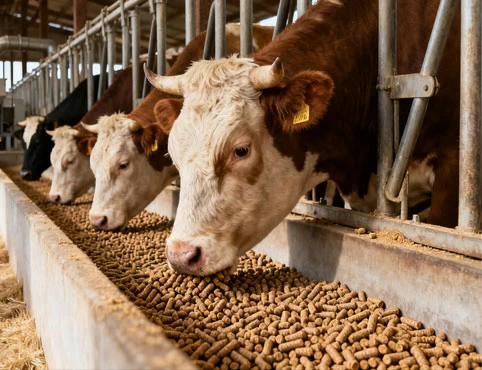
Cattle feed pellets are widely used in modern dairy and beef cattle farming because they are convenient to handle, easy to transport, and can provide a consistent combination of grains, protein sources, fiber, minerals, and other feed ingredients. However, producing high-quality cattle feed pellets is not simply a matter of putting raw materials into a pellet mill. It involves a series of technologies, including raw material preparation, grinding, batching, mixing, conditioning, pelletizing, cooling, screening, and packaging.
Modern cattle feed pellet production technology combines mechanical processing with precise process control. Each stage affects the final pellet quality, production capacity, energy consumption, and operating cost. For commercial feed manufacturers, selecting the right equipment and designing a properly balanced production line are therefore essential.
A complete cattle feed pellet production line may include a cleaning screen, magnetic separator, hammer mill, batching system, feed mixer, conditioner, pellet mill, pellet cooler, vibrating screen, coating machine, packing machine, conveyors, elevators, and an automatic electrical control system.
Understanding these technologies can help feed manufacturers determine what equipment they need, how to improve pellet quality, and how to evaluate investment costs before establishing a cattle feed pellet plant.
What Are Cattle Feed Pellets?
Cattle feed pellets are compact feed products made by compressing a mixture of ingredients through a pellet die.
Depending on the feeding purpose, cattle feed pellets may contain:
- Corn
- Barley
- Wheat
- Sorghum
- Wheat bran
- Rice bran
- Soybean meal
- Sunflower meal
- Cottonseed cake
- Alfalfa
- Grass hay
- Straw
- Molasses
- Minerals
- Vitamin premixes
- Other feed additives
The exact formulation depends on the nutritional requirements of the cattle and the feed manufacturer’s product specifications.
The pellet production process transforms these ingredients from a loose mixture into a more uniform and compact form. This can reduce ingredient separation and make the feed easier to transport, store, and handle.
However, the final quality depends on much more than the pelletizing machine itself. Raw material characteristics, particle size, moisture, formulation, conditioning, die selection, cooling, and screening all contribute to the final product.
What Technology Is Used to Make Cattle Feed Pellets?
Modern cattle feed pellet production generally uses several interconnected technologies.
The major technologies include:
- Raw material cleaning
- Crushing and grinding
- Automatic batching
- Feed mixing
- Steam conditioning
- Mechanical pelletizing
- Pellet cooling
- Pellet screening
- Liquid coating
- Automatic weighing and packaging
- Centralized production control
The following sections explain how each technology contributes to cattle feed pellet production.
1. Raw Material Cleaning Technology
Before cattle feed ingredients are processed, foreign materials should be removed.
Raw materials may contain stones, metal particles, dust, fibers, sand, and other impurities. If these materials enter the production line, they may reduce feed quality or damage processing equipment.
Modern feed factories can use several types of cleaning equipment.
A cleaning screen removes oversized particles and unwanted materials according to particle size. A magnetic separator can remove ferrous metal particles. An aspiration system can separate lighter dust and impurities from heavier feed ingredients.
Cleaning technology provides two important benefits.
First, it helps improve the cleanliness of the feed ingredients. Second, it protects downstream equipment such as hammer mills, mixers, and pellet mills.
For large commercial feed factories, efficient raw material cleaning is an important part of maintaining continuous production.
2. Crushing and Grinding Technology
Grinding is one of the most important preparation technologies in cattle feed pellet production.
Whole grains and other raw materials often need to be reduced to a suitable particle size before they are mixed and pelletized.
Hammer mills are commonly used for this purpose.
The objective is to achieve an appropriate particle size rather than simply producing the finest possible powder.
If particles are too large, the material may be difficult to mix and compress. If the material is excessively fine, grinding energy consumption may increase.
The appropriate grinding size depends on:
- Raw material type
- Feed formula
- Pellet diameter
- Pellet mill design
- Desired pellet durability
- Production capacity
A properly optimized grinding process provides more consistent material for the mixer and pellet mill.
3. Automatic Batching Technology
Cattle feed formulas may contain many ingredients, and each ingredient needs to be added at the correct proportion.
Automatic batching systems use weighing hoppers and dosing equipment to measure ingredients according to a predefined formula.
For example, a formula could contain corn, barley, soybean meal, wheat bran, cottonseed cake, minerals, and other ingredients.
The batching system can separately weigh each component before sending the ingredients to the mixer.
Compared with manual weighing, automated batching can improve:
- Formula accuracy
- Production speed
- Labor efficiency
- Batch consistency
- Production records
- Formula management
This technology becomes increasingly valuable when a feed factory produces several different cattle feed products.
4. Feed Mixing Technology
After batching, the ingredients need to be mixed thoroughly.
Mixing technology is designed to distribute different ingredients throughout the feed mixture as evenly as possible.
This is particularly important when formulas contain small amounts of minerals, vitamins, premixes, or additives.
A modern feed mixer may be designed to handle dry ingredients as well as selected liquid ingredients.
Mixing efficiency depends on several factors, including:
- Mixer type
- Mixing time
- Ingredient particle size
- Moisture content
- Filling level
- Ingredient sequence
- Liquid addition method
If mixing is incomplete, the final pellets may not have consistent ingredient distribution.
Therefore, efficient mixing is a prerequisite for consistent pellet production.
5. Steam Conditioning Technology
Steam conditioning is a major technology used in many commercial cattle feed pellet plants.
Before the feed mixture enters the pellet mill, it can pass through a conditioning chamber where steam is introduced.
The steam increases moisture and temperature while softening the feed particles.
This changes the physical properties of the feed and makes it easier to compress.
Proper conditioning can help improve:
- Pellet durability
- Pellet formation
- Production stability
- Material binding
- Pellet mill throughput
- Reduction of fines
However, conditioning needs to be carefully controlled.
The appropriate temperature and moisture depend on the formulation and raw materials. A grain-based concentrate feed may require different conditions from a high-fiber cattle feed containing large quantities of alfalfa or grass.
This is why conditioning parameters should be established according to the actual feed formula.
6. Mechanical Pelletizing Technology
Mechanical compression is the central technology used to transform prepared feed material into pellets.
During pelletizing, the conditioned feed enters a pellet mill. The material is compressed through holes in a die and formed into cylindrical pellets.
The die determines the approximate diameter of the pellets, while the cutting system controls pellet length.
The pelletizing process is affected by:
- Feed moisture
- Steam conditioning
- Particle size
- Formula composition
- Die diameter
- Die compression ratio
- Roller adjustment
- Feeding rate
- Machine load
A stable combination of these factors helps produce consistent pellets.
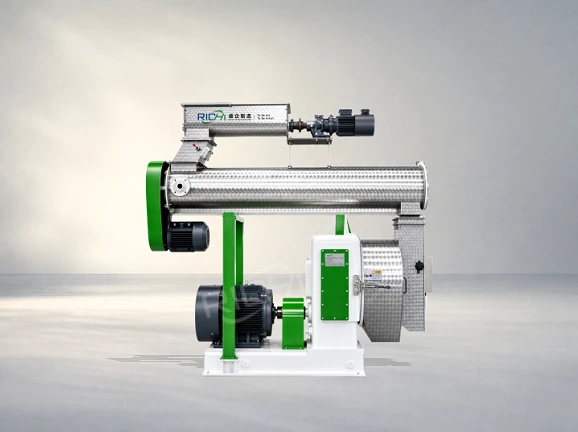
7. The Role of the Cattle Feed Pellet Machine
The cattle feed pellet machine is the core production equipment in many cattle feed pellet plants.
A modern machine needs to handle different feed formulas while maintaining stable production.
When selecting a pellet mill, manufacturers should consider several factors.
Capacity
The machine should provide the required production capacity without becoming a bottleneck in the production line.
Pellet Diameter
Different cattle feed products may require different pellet sizes. The machine should support the required die specifications.
Raw Material Characteristics
High-fiber materials can have different pelletizing characteristics from grain-based formulas.
Die and Roller System
The die and rollers are critical wear components. Their material, design, condition, and adjustment influence pellet formation and operating stability.
Drive System
A stable drive system is important for continuous industrial operation.
Maintenance
The machine should provide convenient access to key wear parts and lubrication points.
Choosing the right pellet mill is therefore a technical decision rather than simply a purchasing decision.
(Learn more: https://richipelletizer.com/cattle-feed-pellet-mill-for-sale)
8. What Affects Cattle Feed Pellet Machine Price?
One of the first questions asked by feed mill investors is often the cattle feed pellet machine price.
However, there is no single price that applies to every machine.
The investment cost can vary significantly according to equipment specifications and project requirements.
Important factors include:
Production Capacity
A small pellet machine for a farm has very different specifications from a commercial ring die pellet mill designed for several tons per hour.
Higher-capacity equipment generally requires larger motors, stronger structures, larger dies, and more advanced supporting systems.
Pellet Mill Type
Flat die pellet mills and ring die pellet mills have different structures, capacities, applications, and investment requirements.
Small-scale production may use a compact machine, while larger commercial feed factories often require industrial ring die systems.
Motor Power
Motor power is related to production capacity and raw material characteristics.
A machine processing high-fiber feed may have different power requirements from one processing a grain-heavy formula.
Die and Roller Configuration
Different pellet sizes and feed formulas can require different die configurations.
Wear-resistant components can also affect the overall equipment cost.
Automation Level
A manually operated machine generally requires a different investment from a fully automated production system.
Automatic feeding, lubrication, monitoring, batching, and control systems can increase the initial investment while reducing manual operation requirements.
Supporting Equipment
The pellet mill itself is only one part of a complete production line.
A complete system may also require:
- Hammer mill
- Mixer
- Conditioner
- Cooler
- Vibrating screen
- Conveyor
- Bucket elevator
- Packing machine
- Electrical control system
Therefore, investors should distinguish between the price of an individual pellet machine and the total investment required for a cattle feed pellet plant.
9. Ring Die Pelletizing Technology
Ring die technology is widely used in medium- and large-scale commercial feed production.
The ring die contains numerous compression holes. Rollers press the prepared feed material through these holes to form pellets.
The main advantages of industrial ring die pelletizing technology include:
- Continuous operation
- High production capacity
- Stable pellet formation
- Multiple pellet diameter options
- Suitability for commercial feed production
The die compression ratio should be selected according to the characteristics of the cattle feed formula.
High-fiber formulas can require different compression conditions from concentrate formulas.
10. Pellet Diameter and Die Technology
The pellet die determines the approximate diameter of the finished cattle feed pellets.
Different cattle feed products may use different pellet diameters depending on the target animals and feeding system.
The die must therefore be selected according to the desired final product.
In addition to diameter, die compression ratio affects the amount of pressure applied during pellet formation.
An inappropriate die can lead to:
- Low production capacity
- High energy consumption
- Poor pellet durability
- Excessive fines
- Unstable operation
Therefore, die selection is an important part of pelletizing technology.
11. Pellet Cooling Technology
Fresh pellets leave the pellet mill at an elevated temperature.
They also contain moisture introduced during conditioning.
The pellets therefore need to be cooled before they can be screened and packaged.
A counterflow cooler or another suitable industrial cooling system can use controlled airflow to reduce pellet temperature and remove excess moisture.
Effective cooling helps:
- Stabilize pellets
- Reduce moisture
- Improve storage characteristics
- Reduce condensation risk
- Improve handling
- Prepare pellets for packaging
The cooler should have sufficient capacity to match the output of the pellet mill.
If the cooler is undersized, it can become a bottleneck in the entire production line.
12. Pellet Screening Technology
After cooling, pellets are usually screened.
A vibrating screen separates qualified pellets from fines and broken particles.
The qualified pellets continue toward packaging, while fines can potentially be returned to the production process.
Screening improves the consistency of the final product and reduces the amount of loose material in packaged feed.
This is particularly important for commercial feed manufacturers because product appearance and physical consistency are important parts of product quality.
13. Liquid Coating Technology
Some cattle feed formulas contain liquid ingredients that can be added after pelleting.
A coating machine can spray selected liquids onto the surface of cooled pellets.
Depending on the formulation, these materials may include oils, selected nutrients, flavors, or other approved feed ingredients.
Post-pellet coating can provide greater flexibility because some ingredients may not be suitable for exposure to the temperature and pressure conditions inside the pellet mill.
The coating system should be designed according to the properties and dosage requirements of the liquid ingredient.
14. Automatic Packaging Technology
Packaging is the final stage of many cattle feed production lines.
Automatic packing systems can weigh feed, fill bags, correct the weight, and seal the packages.
Compared with manual packaging, automated systems can provide:
- More consistent bag weights
- Faster packaging
- Lower labor requirements
- Improved production records
- Easier finished-product handling
Packaging capacity should be matched to the output of the pellet mill.
If a plant produces 10 tons of feed per hour but the packing system can only handle 5 tons per hour, packaging becomes a bottleneck.
15. Conveyor and Material Handling Technology
Efficient material handling is essential in a modern feed factory.
Raw materials and finished pellets may be transported using:
- Belt conveyors
- Screw conveyors
- Chain conveyors
- Bucket elevators
- Other mechanical conveying systems
The equipment should be arranged to create a logical material flow.
A well-designed factory minimizes unnecessary movement between production stages.
This can reduce:
- Material handling time
- Energy consumption
- Labor requirements
- Product losses
- Maintenance requirements
Material handling should therefore be considered during the initial factory design.
16. Centralized Automation Technology
Modern cattle feed plants increasingly use centralized electrical control systems.
Operators can monitor and control major equipment from a central control room or panel.
Depending on the system, automation can manage:
- Ingredient batching
- Grinding
- Mixing
- Conditioning
- Pelletizing
- Cooling
- Screening
- Packaging
Automation can also provide alarms and operating data.
For large plants, centralized control helps operators coordinate different machines and identify abnormal conditions more quickly.
17. Moisture Control Technology
Moisture management is important throughout the pellet production process.
Raw materials may arrive with different moisture levels. Steam conditioning then adds additional moisture, while cooling removes heat and some moisture before packaging.
Operators should therefore monitor moisture at different stages.
Important points include:
- Incoming ingredients
- Mixed feed
- Conditioned feed
- Fresh pellets
- Cooled pellets
- Finished packaged feed
Proper moisture control helps maintain pellet stability and storage performance.
18. Technology for High-Fiber Cattle Feed
High-fiber cattle feed can present additional processing challenges.
Materials such as alfalfa, grass hay, and straw have long fibers and different physical characteristics from grains.
A suitable production line may include bale breakers, forage crushers, hammer mills, mixers, conditioners, and specialized pellet mills.
The raw material may need to be reduced to a suitable size before mixing and pelleting.
For high-forage formulas, the pellet mill needs sufficient compression capability and stable material feeding.
Therefore, a feed plant producing high-fiber cattle pellets should be designed differently from a plant producing primarily grain-based concentrate feed.
19. How Technology Reduces Feed Waste
Feed waste can occur at several stages.
During grinding, excessive dust may be generated.
During mixing, poorly designed equipment can leave material residues.
During pelleting, weak pellets can generate fines.
During conveying, poor transfer points can result in material losses.
During packaging, inaccurate weighing can create additional waste.
Modern production technology addresses these problems through improved equipment design and process control.
Reducing waste can increase the percentage of raw material converted into saleable finished feed.
20. How Technology Improves Pellet Durability
Pellet durability is an important physical characteristic.
Cattle feed pellets may be transported by conveyors, elevators, trucks, and other handling systems.
If the pellets are weak, mechanical impact can cause breakage and generate fines.
Pellet durability depends on several production factors.
These include:
- Raw material composition
- Particle size
- Moisture
- Conditioning
- Die compression ratio
- Roller adjustment
- Pellet mill operation
- Cooling
- Screening
This means that improving pellet durability requires optimization of the complete production process.
21. Energy-Efficient Pellet Production
Energy consumption is an important consideration for commercial cattle feed plants.
Grinding and pelleting are often significant electricity consumers.
Energy efficiency can be improved by selecting equipment according to actual production requirements and optimizing operating parameters.
For example, excessive grinding can increase electricity consumption. Incorrect die selection can increase pellet mill load. Poor conditioning can reduce pelleting efficiency.
Regular maintenance is also important.
Worn hammers, inefficient bearings, poorly adjusted rollers, or other mechanical problems can increase energy consumption.
Monitoring electricity consumption per ton of finished feed can help operators identify unusual changes.
22. Preventive Maintenance Technology
Efficient feed production depends on reliable equipment.
Unexpected equipment failures can stop the entire production line.
Preventive maintenance should therefore be incorporated into daily operations.
Important maintenance tasks include:
- Checking hammer mill hammers
- Inspecting screens
- Lubricating bearings
- Checking mixer components
- Inspecting pellet mill dies
- Checking rollers
- Monitoring drive systems
- Cleaning coolers
- Inspecting conveyors
- Maintaining packing machines
The maintenance interval should be based on operating hours, equipment design, manufacturer recommendations, and actual operating conditions.
23. Automation Improves Production Efficiency
Automation can reduce repetitive manual operations while improving process consistency.
For example, an automated system can control ingredient quantities and production sequences.
It can also coordinate equipment start-up and shutdown.
This reduces the risk of operating machines in an incorrect sequence.
In large plants, automation may also record production data, equipment alarms, and batch information.
These functions make it easier to manage production and analyze operating performance.
24. Technology for Different Cattle Feed Formulas
Different cattle feed formulas may require different processing technologies.
Dairy Cattle Feed
Dairy feed formulas may contain grains, protein meals, bran, minerals, and other ingredients designed around dairy production requirements.
Beef Cattle Feed
Beef cattle feed can use grain-based concentrates, protein sources, forage ingredients, and agricultural byproducts.
High-Fiber Feed
Alfalfa, grass, and straw-based formulas require attention to fiber preparation and pelletizing conditions.
TMR-Related Products
TMR-related feed products may contain a combination of forage and concentrate ingredients and can require specialized processing depending on the final product.
Because these formulas behave differently during production, equipment selection should always be based on actual formulation requirements.
25. How to Build an Efficient Cattle Feed Pellet Production Line
A complete cattle feed pellet plant should be designed as an integrated system.
A typical process can be arranged as:
Raw Material Receiving → Cleaning → Crushing → Batching → Mixing → Conditioning → Pelletizing → Cooling → Screening → Coating → Packaging
Not every plant requires every stage.
For example, some formulas may not require drying, while others may need additional forage preparation.
A customized process design can determine which equipment is necessary and how each stage should be connected.
26. How to Evaluate Cattle Feed Pellet Production Equipment
When comparing different machines, investors should consider more than the purchase price.
The following factors should be evaluated:
Production Capacity
Determine the required tons per hour.
Raw Material Compatibility
Confirm that the machine can process the intended ingredients.
Pellet Specifications
Check whether the machine can produce the required pellet diameter and quality.
Energy Consumption
Compare power requirements relative to actual output.
Wear Parts
Consider the durability and replacement requirements of dies, rollers, hammers, and other wear components.
Automation
Determine how much manual operation is required.
Maintenance
Check whether routine maintenance can be performed efficiently.
Technical Support
For a complete plant, installation, commissioning, operator training, and after-sales service can be important considerations.
A lower initial machine cost does not necessarily mean a lower total production cost. The long-term operating performance of the equipment should also be considered.
27. Individual Pellet Machine vs Complete Production Line
An individual pellet machine may be sufficient for small-scale operations with prepared feed material.
However, commercial cattle feed production generally requires more equipment.
A complete production line can integrate:
- Raw material preparation
- Grinding
- Batching
- Mixing
- Conditioning
- Pelletizing
- Cooling
- Screening
- Packaging
The advantage of a complete line is that the equipment can be matched according to capacity and process requirements.
For example, the hammer mill output should be sufficient for the mixer and pellet mill. The cooler should match pellet mill capacity, while the screening and packaging systems should also handle the finished output.
28. Why Customized Technology Matters
There is no universal cattle feed pellet production process.
A feed factory in one region may have access to corn and soybean meal, while another may rely more heavily on barley, wheat bran, alfalfa, straw, cottonseed cake, or agricultural byproducts.
Local raw materials therefore influence equipment selection.
Customized engineering can consider:
- Raw materials
- Feed formulas
- Production capacity
- Pellet size
- Factory dimensions
- Electricity supply
- Steam availability
- Labor conditions
- Automation requirements
- Future expansion
This allows the production line to be designed around the actual project rather than a generic equipment package.
(click here to investigate: RICHI PELLETIZER)
29. The Importance of Process Testing
Before finalizing a large cattle feed plant, process testing can help determine appropriate equipment parameters.
Testing may evaluate:
- Grinding performance
- Mixing uniformity
- Conditioning requirements
- Pellet formation
- Pellet durability
- Production capacity
- Energy consumption
- Cooling performance
Testing is particularly valuable when the formula contains unusual or difficult-to-process raw materials.
It can help identify potential problems before large-scale equipment is installed.
30. Future Development of Cattle Feed Pellet Technology
Cattle feed pellet production is increasingly moving toward greater automation, process integration, energy efficiency, and data-based management.
Future feed factories are likely to use more advanced control systems to monitor production parameters.
Automation can help manage formulas, equipment operation, production records, alarms, and maintenance information.
At the same time, manufacturers are expected to continue using a wider range of agricultural byproducts and locally available feed resources.
This means production systems need to become more flexible.
The focus will increasingly shift from simply increasing machine capacity toward optimizing the complete production process.
Conclusion
Modern cattle feed pellet production uses a combination of mechanical, thermal, automation, and material-handling technologies.
The process normally begins with raw material cleaning and grinding, followed by accurate batching and mixing. Steam conditioning prepares the feed mixture for compression, while the pellet mill forms the material into compact pellets. Cooling and screening then stabilize and clean the finished product before packaging.
The cattle feed pellet machine price is influenced by many factors, including production capacity, machine type, motor power, die and roller configuration, automation level, and supporting equipment. Therefore, investors should not evaluate pellet mill cost based only on the machine itself. The total production-line configuration and long-term operating requirements should also be considered.
A successful cattle feed pellet plant should match equipment capacity with the characteristics of the feed formula and raw materials. Grinding, mixing, conditioning, pelletizing, cooling, screening, and packaging must work together as one coordinated system.
For small farms, a compact pellet machine may be sufficient. For commercial manufacturers, an integrated automated cattle feed production line can provide higher capacity, more consistent product quality, and better process control.
Ultimately, the most appropriate technology depends on the specific project. By analyzing raw materials, feed formulas, required capacity, pellet specifications, factory conditions, and future expansion plans, feed producers can build a cattle feed pellet production system that balances product quality, production efficiency, equipment investment, and long-term operating costs.