







Goat farming has a reputation for being forgiving. The animals browse widely, tolerate rough forage, and produce meat and milk on land that would not support cattle. That reputation is partly earned. But it hides a problem that shows up on almost every goat farm eventually: feed form.
Two farms can feed the same ingredients and get very different results. One has steady growth, low mortality, and does well through the dry season. The other struggles with sorting, waste, and animals that never quite reach condition. The difference is often not what they feed, but how it is processed and presented.
Goats are selective. They have mobile lips, a strong sense of smell, and clear preferences for texture. In a loose mixed ration, they will eat the grain and leave the fiber, or pick out the palatable bits and ignore the mineral premix. The ration you formulated is not the ration they actually consume. That gap costs money and shows up in animal performance.
This is where a goat feed pellet machine earns its place on a farm. It turns a loose, sortable mix into a uniform pellet that every animal eats in roughly the same proportion. But pelleting is only useful if the formula going into the machine is sound, and if the machine is set up for the ingredients being used. Grass and grain formulas behave differently from high-concentrate mixes, and the equipment has to match.
This article looks at feed form as a management issue, not just a machinery question. It covers why goats sort feed, how pelleting changes the picture, what grass and grain formulas require, and what farmers should think about before investing in equipment.
Why Goats Sort Feed and Why It Matters
Sorting is not a bad habit. It is normal ruminant behavior. In the wild, goats balance their own diet by selecting from a wide range of plants. They eat leaves, shrubs, bark, and weeds, adjusting intake based on what their body needs. That ability is an advantage on rangeland. In a pen, it becomes a problem.
When you offer a loose mixed ration, goats apply the same selective logic. They eat the parts that taste good and leave the rest. The parts they leave are often the ones you paid the most for: protein supplements, minerals, and additives. Over time, the animals that sort most aggressively develop deficiencies, while the ones that eat everything get a heavier dose than intended.
There is also physical waste. Goats pull feed from troughs, drop it on the ground, and refuse to eat what has been trampled. With loose meal, losses of 10 to 20 percent are common. On a small farm, that is a meaningful share of the feed budget. On a larger operation, it adds up quickly.
Sorting and waste interact. The more a ration can be sorted, the more waste there is, because the rejected portions are the ones that end up on the ground. A ration that cannot be sorted is a ration that cannot be wasted in the same way.
What Pelleting Changes
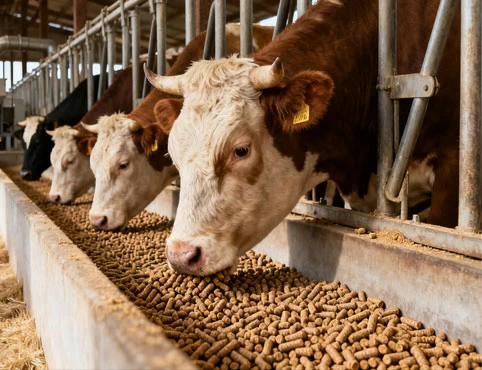
Pelleting addresses sorting directly. When ingredients are ground, mixed, and pressed through a die, they become a single uniform unit. A goat cannot eat the grain out of a pellet and leave the fiber behind. Every bite contains the same proportion of ingredients as every other bite.
That uniformity has several effects.
First, nutrient intake becomes predictable. You know roughly what each animal is consuming, because they cannot selectively eat. That makes formulation more reliable and deficiency less likely.
Second, waste drops. Pellets are harder to pull apart and less likely to be trampled into the ground. Feed conversion improves because more of what you offer is actually eaten.
Third, handling gets easier. Pellets flow. They can be measured, bagged, and distributed with simple equipment. On farms where labor is limited, that matters.
Fourth, storage improves. Pellets are less bulky than loose meal in some cases, and they are less prone to segregation during transport. If kept dry, they store well.
There is also a digestibility effect. The heat and pressure of pelleting partially gelatinize starch and soften fiber, which can make nutrients more accessible to the animal. The effect varies by ingredient, but it is generally positive.
None of this is automatic. A poorly formulated pellet is still a poor ration. A pellet made with the wrong die can be crumbly and produce just as much waste as meal. The machine and the formula have to work together.
Grass and Grain Formulas Behave Differently
Goat rations vary widely depending on region, season, and production goal. Some are built around forage, with grain as a supplement. Others are built around grain, with forage included mainly for rumen health. These two types of formula behave very differently in a pellet mill.
Grass-based formulas are high in fiber. Fiber is difficult to pelletize because it does not bind easily and requires more pressure and moisture to form a durable pellet. Die selection matters enormously. A die with the wrong compression ratio will either produce soft pellets or overheat the machine. Moisture control is also critical, because dry, fibrous material may not bind at all.
Grain-based formulas pelletize more easily. Starch acts as a natural binder, so pellets form readily and hold together well. The risk here is different: too much starch can create a pellet that is too hard, which reduces intake, or that generates excessive heat during pelleting, which can damage vitamins and enzymes.

A practical farm ration usually sits between these extremes. It includes enough forage for rumen health and enough grain for energy. The goat feed pellet machine for grass and grain formulas category exists precisely because these mixed rations require equipment that can handle both fibrous and starchy ingredients without constant adjustment.
Farmers should think about their typical formula before choosing a machine. A farm that relies heavily on crop residues and browse will need a different setup from one that feeds mostly grain with a bit of hay. The machine, the die, and the moisture strategy should all be matched to the dominant ingredients.
Getting the Formula Right Before the Machine
Equipment cannot fix a bad formula. If the ration is imbalanced, pelleting will simply produce uniform bad feed. Formulation comes first.
A sound goat ration balances several things:
- Energy, usually from grain, molasses, or by-products
- Protein, from legume forage, oilseed meals, or commercial supplements
- Fiber, from grass, hay, or crop residues, needed for rumen function
- Minerals, especially calcium and phosphorus, plus trace elements
- Vitamins, particularly A, D, and E, which may degrade during storage and processing
- Palatability, which affects intake and varies with ingredient choice
The proportions depend on the class of animal. A dry doe maintenance ration is different from a lactating doe ration, which is different again from a growing kid ration. Breeding bucks have their own needs. Trying to feed one formula to the whole flock usually means some animals get too much and others too little.
For many farms, the practical approach is to work with an extension officer, a nutritionist, or an experienced feed supplier to develop a base formula. That formula can then be adjusted as ingredient availability and prices change. The goal is not a perfect formula, but a reliable one that meets the animals’ needs without excessive cost.
Matching the Machine to the Farm
Equipment selection is where many farms go wrong. The temptation is to buy on price or on claimed capacity, without considering how the machine will actually be used.
Capacity is the first issue. A small farm with a few dozen goats may need only a few hundred kilograms of feed per day. A commercial operation may need several tons. An oversized machine wastes power and wears out from intermittent use. An undersized machine becomes a bottleneck during busy periods.
Power supply is the second issue. Pellet mills are power-hungry, especially when pressing high-fiber material. A machine rated for a certain output may only achieve that output with a specific ingredient mix and a stable power supply. Farms with weak or intermittent electricity need to plan for that reality, whether through a generator, a smaller machine, or a different processing schedule.
Die configuration is the third issue. Different ingredients require different die compression ratios. A die suited to grain will not perform well on high-fiber forage, and vice versa. Farms that change formulas seasonally may need more than one die, or a machine that can be adjusted easily.
Moisture control is the fourth issue. Pelleting works within a narrow moisture range. Too dry, and the feed will not bind. Too wet, and the pellets will be soft and prone to mold. In humid climates, ingredients may need drying before pelleting. In arid regions, water may need to be added. Both require attention and some skill.
Maintenance and support are the fifth issue. Pellet mills have wearing parts, especially dies and rollers. A machine that cannot be repaired locally becomes a liability. Buyers should confirm that spare parts and technical advice are available before purchase, not after.
Richi Pelletizer is one supplier that focuses on pellet production equipment for agricultural use, including small ruminant feed. For farms comparing options, reviewing the manufacturer’s equipment range and support approach is a sensible part of the decision. Farmers who want to understand the company’s background and how it works with customers can check my source for more detail on its experience and equipment selection process.
Practical Feeding Management
Even with good pellets, management matters. How feed is offered affects how much is eaten and how well animals perform.
Trough design is important. Goats need enough space to eat without competition. Crowding at the trough leads to stress and uneven intake. Shallow troughs with a lip reduce spillage. Clean troughs reduce disease risk.
Feeding frequency matters too. Goats do better with consistent feeding times. Sudden changes in ration or schedule cause digestive upset. When switching from one formula to another, do it gradually over several days.
Water access is often overlooked. Goats need clean water available at all times. Pellets are dry, and animals eating dry feed drink more. Without adequate water, intake drops and performance suffers.
Observation is the simplest quality control tool. Watch the animals. Are they eating eagerly? Are they leaving feed? Are their droppings normal? Are they maintaining condition? These signs tell you more about ration quality than any laboratory test in most farm settings.
Cost and Payback
Feed is the largest recurring cost in goat production, just as it is in other livestock systems. Pelleting changes the cost structure, but not always in the same direction.
On the positive side, pelleting reduces waste, improves feed conversion, and allows the use of cheaper local ingredients. It also reduces labor in feeding. On the negative side, it requires an upfront investment, power, maintenance, and some technical skill.
The payback period depends on scale and local conditions. A farm that replaces purchased feed with home-produced pellets may see a faster return than one that continues buying feed and uses the machine only occasionally. A cooperative that shares a machine across several households can justify a larger investment than any single household.
The calculation should include not just the machine, but the whole system: grinding, mixing, storage, and power. A machine without adequate storage or power is a machine that will not run reliably.
Common Mistakes and How to Avoid Them
Several mistakes appear repeatedly when farms adopt pelleting.
Buying a machine without confirming the power supply is one. A machine rated for three-phase power will not run properly on a single-phase line. The result is poor performance and frustration.
Choosing the wrong die is another. Each ingredient mix has different pelleting characteristics. Using a die that is too loose or too tight leads to poor pellet quality, high energy consumption, or both.
Ignoring moisture is a third. Pelleting works within a narrow moisture range. Farms that do not measure moisture will struggle to produce consistent pellets.
Skipping maintenance is a fourth. Dies wear, rollers need adjustment, bearings need lubrication. A machine that is not maintained will fail at the worst possible time.
Neglecting storage is a fifth. Pellets that are stored in damp conditions will mold. Storage is part of the system, not an afterthought.
What Good Feed Form Delivers
When feed form is right, several things improve at once.
Animals eat more consistently, because they cannot sort. Growth becomes more predictable. Kids reach market weight sooner. Does maintain condition through lactation. Mortality among young animals drops.
Feed conversion improves. More of what you offer is actually eaten and digested. That reduces the cost per kilogram of gain or per liter of milk.
Labor becomes easier. Pellets are simple to measure and distribute. Cleanup is faster. For households where animal care competes with other work, that saved time matters.
Storage and transport become more manageable. Pellets flow and stack well. They can be bagged and sold if there is a market for surplus.
None of these benefits are guaranteed. They depend on a sound formula, a properly matched machine, and consistent management. But when those conditions are met, feed form becomes one of the most reliable levers a goat farm can pull.
Planning for the Long Term
A pellet machine is a long-term investment. The purchase price is only the beginning. Dies, rollers, bearings, and power add to the operating cost. Ingredient sourcing and storage require planning. Labor and maintenance require commitment.
The farms that get the most from pelleting are the ones that treat it as a system. They match the machine to their ingredients. They match their formula to their animals. They plan for maintenance and support. And they stay realistic about the volume needed to justify the investment.
Goats are resilient, but resilience is not the same as performance. A farm that feeds them well gets more meat, more milk, and more income from the same land and labor. Feed form is one of the simplest ways to make that happen.